Thirsty for more expert insights?

Subscribe to our Tea O'Clock newsletter!

Subscribe

Enhancing 1st-Party Analytics with GTG: The Key to Data Uplift

Vlad Zamfir
No items found.
Published on
27/4/2026
In our current privacy-first digital landscape, marketers face mounting challenges in collecting behavioural data from users. Modern browsers are continuously tightening their privacy controls, making traditional tracking methods less reliable. For example, some browsers, Safari chief among them, can block certain 3rd party tools like GTM from loading, irrespective of user consent choices.

The impact of this evolution can already be seen across a number of areas, from reduced web analytics data and smaller audience pools to decreased marketing campaign performance. Google Tag Gateway (GTG) provides marketers with a solution to this challenge by guarding against data loss by shifting data collection to the server-side, or 1st party.

What is Google Tag Gateway?

Google Tag Gateway, or GTG, is solution to set up tracking so that Google scripts (such as GTM and gtag) get loaded as 1st party (i.e. from your servers) rather than 3rd party (i.e. Google servers). Deploying GTG leads to more complete tracking, enabling increased data collection across your Google platforms to support improved measurement, insights & campaign performance.

GTG’s benefits:

  • Improved data collection: A larger proportion of users interacting with the website are tracked
  • Better data modelling: Google’s Behavioural Modelling can use the additional data collected through GTG to better model unconsented events (if Advanced Consent Mode is enabled)
  • User reporting accuracy increases: Safari restricts the lifespan of 1st party cookies if there's insufficient proof they are set by the client’s servers. In cases where these cookies are used to store user identifiers, their shortened lifespan can lead to inflated user metrics. Best-practice GTG implementations mitigate these effects, enabling more accurate user reporting

Insights from Google Tag Gateway Deployments

Having delivered this across a number of global brands that span multiple industries and verticals, we have seen our clients consistently benefit from GTG against a number of key business metrics:

  •  +20% average uplift in Safari users
  •  +9% uplift in event & conversion volume for Safari users

Our Five Key Takeaways

  1. Safari is the main driver of uplift: Safari uplift for events and conversions was 6x higher than the baseline for other browsers.
  2. Website Audience matters: Safari traffic share varies significantly between brands, which means GTG impact is closely tied to a brand’s audience and their browsing behaviours.
  3. Sensitive verticals benefit most: Brands in categories where private or restricted browsing is more common, experienced the highest recovery in data.
  4. The biggest challenge is procedural rather than technical: CDN configuration changes require security reviews and approval from multiple teams, which can extend timelines particularly in larger organisations.
  5. Data partners can help accelerate: GTG rollouts often require input from multiple technical stakeholders, working with a trusted data partner can help in identifying and orchestrating the necessary teams to speed up delivery.

GTG Implementation options

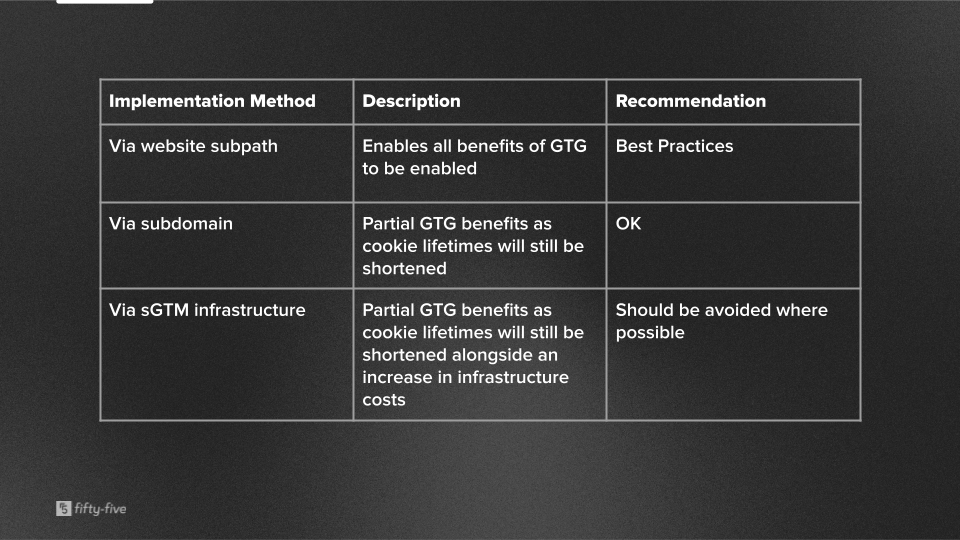
To setup GTG, it should be either implemented on the main website as a subpath (e.g. www.example.com/subpath) or as a subdomain (subdomain.example.com). Both will require a Content Delivery Network (CDN) configuration to be carried out.

Our recommendation is to implement GTG via the website subpath to maximise GTG’s incremental benefits.

GTG Implementation Recommendations

Conclusion

With modern browsers tightening their privacy controls for 3rd party domains, collecting reliable behavioural data is increasingly difficult for marketers. Google Tag Gateway (GTG) directly addresses this by serving Google tracking scripts as 1st party assets.

Through implementing GTG, brands can achieve improved data collection, better data modelling , and more accurate user reporting. Although deployments often require navigating procedural hurdles like CDN configuration approvals across multiple teams , the results—including a 20% average uplift in Safari users — demonstrate that GTG is invaluable in enabling higher-quality data collection and, therefore, better decision making.

All articles

Related articles

How to achieve resilience, agility, and control over data with server-side tracking

5 mins
Alain Friedli

Data Privacy in the US: What GPC Is, Why It Matters, and What You Should Do About it

4mn
Josselin Merckaert

Digital Omnibus: A Privacy and AI Revolution for Europe?

02 min
Guillaume Tollet

Thirsty for more expert insights? Subscribe to our monthly newsletter.

Discover all the latest news, articles, webinar replays and fifty-five events in our monthly newsletter, Tea O'Clock.

First name*
Last name*
Company*
Preferred language*
Email*
Merci !

Votre demande d'abonnement a bien été prise en compte.
Oops! Something went wrong while submitting the form.