
Thirsty for more expert insights?

Subscribe to our Tea O'Clock newsletter!

Subscribe

How Next-Gen MMMs Transform Marketing ROI Measurement and Management

Pierre-Charles Lunel
No items found.
Published on
26/11/2026

‍

Key Takeaways

  • The market reality: While 70%1 of major advertisers use a Marketing Mix Modeling (MMM) model, only 10%1 say they are fully satisfied with traditional solutions. These legacy approaches suffer from a lack of granularity, overly long update cycles, opacity (the "black box" problem) and a purely backward-looking perspective.
  • The methodological shift: The market is moving from historical frequentist approaches (such as Meta Robyn) towards Bayesian models (Google Meridian, PyMC Marketing), driven by an open-source innovation movement (Google, Meta, PyMC Labs, Uber…).
  • fifty-five's answer: A progressive range of three offerings tailored to each company's maturity and needs: Bayesian Open-Source Model (Meridian, PyMC), AI-Augmented Meridian, and the Digital Twin Model (DTM).
  • The DTM technological breakthrough: Through Agent-Based Modeling (ABM), the DTM shifts from a Top-Down analysis to a Bottom-Up approach by analyzing a virtual population of synthetic consumers (Digital Twins). It turns MMM from a historical report into a true steering tool, used both to understand the past and to simulate the impact of decisions on several KPIs (Acquisition, Sales, Consideration, Awareness...) with greater granularity.
  • The winning synergy: Meridian or PyMC and the DTM can form a continuous steering loop, in which the DTM sets the long-term strategic course while Meridian or PyMC provides agile, frequent short-term monitoring.

1. Why MMM (Marketing Mix Modeling) Must Reinvent Itself

While performance measurement has always been a major concern for marketers, the discipline is now more critical and more complex than ever. With the end of third-party cookies, the fragmentation of channels (Connected TV, TikTok, Retail Media, Influencer marketing) and growing pressure on budgets, measuring the real effectiveness of media investments has become a genuine balancing act for marketing departments. The historical solution to these measurement challenges? Marketing Mix Modeling, or MMM.

Marketing Mix Modeling (MMM) seeks to measure the causal impact of marketing spend (media, sponsorship, pricing, promotions) on a specific performance KPI (sales, revenue, customer acquisition). Historically, MMM has relied on econometric methods designed to determine the exact impact of a change in media budget on a core business metric. It provides a rigorous answer to a question that is crucial for any CFO or CMO: "If I cut or reduce a given marketing lever, what is the exact impact on my sales?" 

Yet while a large majority of major advertisers now use Marketing Mix Modeling (MMM) to steer their investments, only a minority say they are truly satisfied with traditional solutions. Indeed, traditional approaches run into major roadblocks:

  1. Slow refresh cycles: Reports delivered months after campaigns have ended, acting as a rear-view mirror rather than a GPS. This is largely due to a lack of automation in collecting and processing the data the model needs.
  2. Lack of granularity: An inability to drill down to a fine geographic level, or to the level of campaign objectives, formats, specific channels, product categories or audience segments.
  3. Model opacity and no lasting value: SaaS MMM solutions often operate as black boxes. The specifics of the brand and its market are poorly taken into account, and results are hard to explain internally. The resulting lack of trust holds teams back from acting on them. Moreover, the investment leaves the advertiser with no lasting asset (model, data, know-how).
  4. Confusing correlation with causation: The difficulty of isolating the true incrementality of sales.
  5. Limited handling of synergies: The inability to measure cannibalization or complementarity between levers (e.g. the effect of TV on paid search).
  6. Short-term focus: Underestimating brand building (Brand Power, consideration, LTV) in favor of immediate ROI.

At the same time, on the methodological front, the market is undergoing a transformation, gradually moving away from frequentist approaches2 focused solely on explaining the past in favor of Bayesian models. 

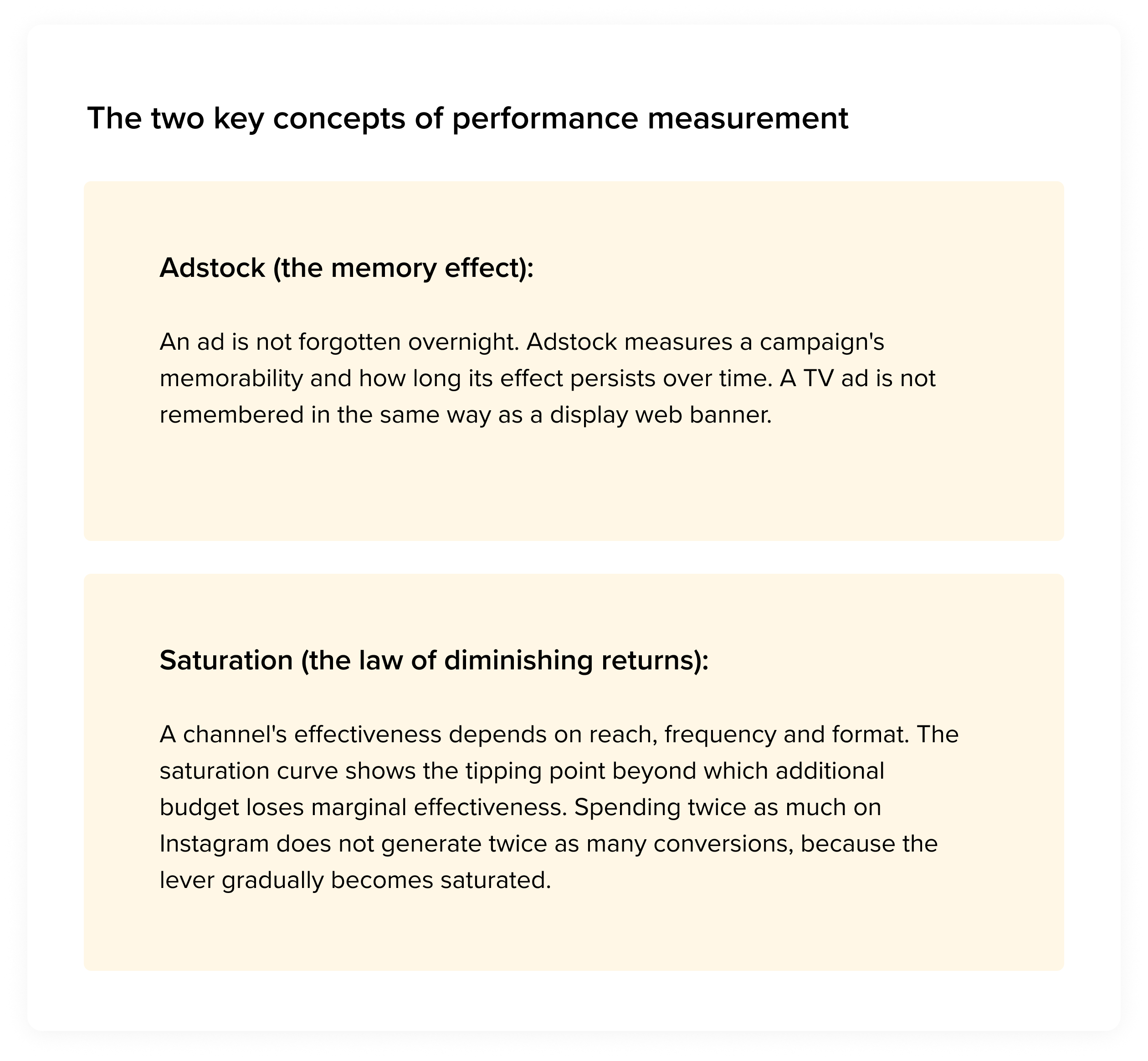
Led by the open-source momentum of major tech players and specialized labs, Bayesian modeling3 makes it possible to combine historical analysis with business knowledge known as priors. This statistical rigor is built around two fundamental mechanisms for interpreting marketing performance: Adstock, which reflects how long advertising stays in memory over time, and Saturation, which defines the point of diminishing returns beyond which additional investment loses effectiveness.
2. Decoding fifty-five's 3 Major MMM Offerings

To meet the full range of performance needs without imposing a one-size-fits-all model, fifty-five offers a modular approach made up of three complementary solutions of increasing complexity.

A. The High-Performance Open-Source Standard

What is it?

Built on the open-source Bayesian algorithmic frameworks developed by Google and PyMC Labs, Meridian and PyMC Marketing are the modern, transparent standards for marketing performance measurement. They analyze aggregated media and sales data, incorporating detailed geographic (national, regional…) and time dimensions.

fifty-five's expertise:

Their value lies in expert implementation by our teams. We have built extensive experience through numerous deployments of these two models for different advertisers, across different brands and markets. Their use is packaged, and our MMM expertise allows us to configure the Bayesian framework with your business data (priors) and leverage your past incrementality tests (Lift Tests) to calibrate the model and move from simple correlation to true causation.

  • Strengths:
    • Transparency and independence: 100% open models, with no recurring SaaS license.
    • Streamlined cost: fifty-five's experience with these models means projects can get off the ground quickly, building on our previous deployments 
    • "Go far, one step at a time" approach: Ideal for securing initial quick wins and proving the value of MMM before scaling up.
  • Limitations:
    • An aggregate-based (Top-Down) approach that makes it harder to drill down to a fine media level 
    • Limited ability to simulate unprecedented or highly disruptive scenarios.
    • Only one KPI per model, so complex multi-KPI needs require multiple models, which are hard to maintain and can lead to consistency issues

B. AI-Powered Meridian/PyMC: Near-Continuous Measurement through MMM Data Platform Automation

What is it?

This offering takes the robust structure of Meridian or PyMC and augments it with an architecture of Artificial Intelligence Agents at every step of the process.

The 3 types of AI agents deployed:

  1. Data Control Tower Agent (QA-QC): Automates data collection and performs real-time quality control to detect anomalies.
  2. Modeling Supervisor Agent: A modeling supervisor able to check statistical quality and propose specification adjustments, validated by a data scientist.
  3. Generative Insights & Chatbot Agent: A natural-language assistant for querying the model's results directly.
  • Strengths:
    • "Better, Faster, Cheaper": A major productivity gain for teams.
    • Moving to "Always-On" MMM: Shorter refresh times and lower refresh costs, enabling continuous budget optimization.
  • Limitations:
    • Same as in section A at model level 
    • Technical and technological prerequisites for industrializing data flows 

C. The Digital Twin Model (DTM): The Ultimate Behavioral Simulator

What is it?

The Digital Twin Model (DTM) is the major technological breakthrough developed by fifty-five. Rather than calculating statistical averages on aggregates (a Top-Down approach), the DTM takes a Bottom-Up approach based on Agent-Based Modeling (ABM). It recreates a synthetic population4 of between several thousand and one million Digital Twins (virtual consumers) representative of your market (age, gender, location, media habits, brand perception).

A Digital Twin's decision journey:
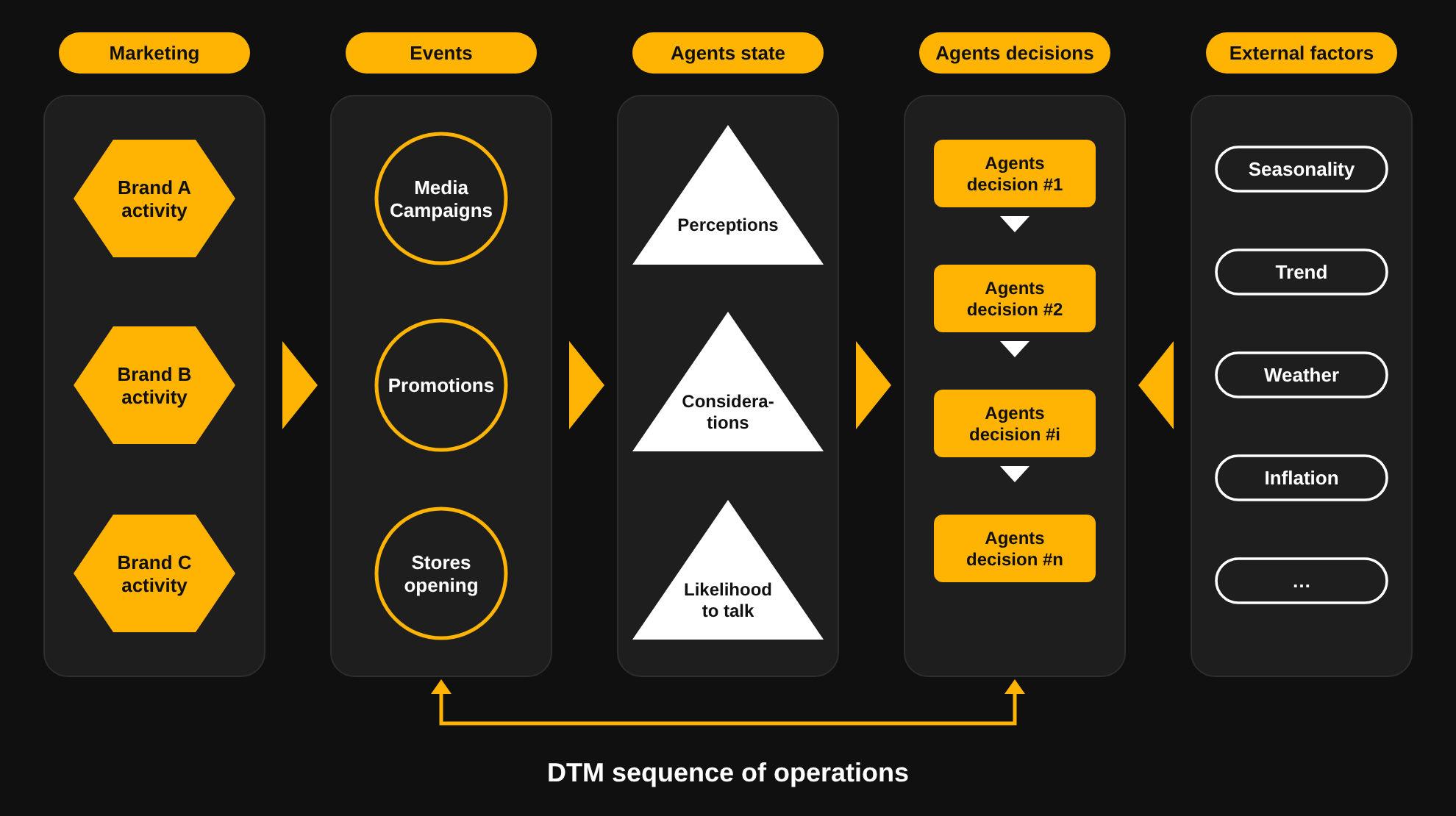
  1. Maturation: Various marketing stimuli (media campaigns, promotional offers, pricing, event sponsorship), whether from a brand or its competitors, act on the individual to build up their "capital" of perception/awareness/consideration towards one or more brands.
  2. Purchase need: An event triggers the need to buy. This event may be linked to a "life moment" for the individual (moving house, end of a contract), to the calendar (back to school, Christmas) or to external events prompting the individual to make a purchase
  3. The Final Decision: The twin's choice of brand combines perception, consideration, physical proximity and digital presence. Its decision is therefore influenced by both short- and long-term effects. 
  • Strengths:
    • Built on MMM fundamentals: The DTM incorporates the concepts of Adstock and Saturation directly at the individual level of each agent, taking into account the precise effect of each medium on a given segment of the population (e.g. the same Instagram campaign does not reach the same twins, and does not have the same effect depending on their state).
    • Strategic flight simulator: Lets you test "What-If" scenarios never observed in historical data (e.g. "What happens if I stop TV and switch to TikTok?"). The question is no longer "what does each lever deliver?" but "can I do better with the same budget?".
    • Measuring synergies & Word-of-Mouth: Models how channels reinforce each other (TV + paid search) or cannibalize each other (TV + Social), as well as peer-to-peer influence.
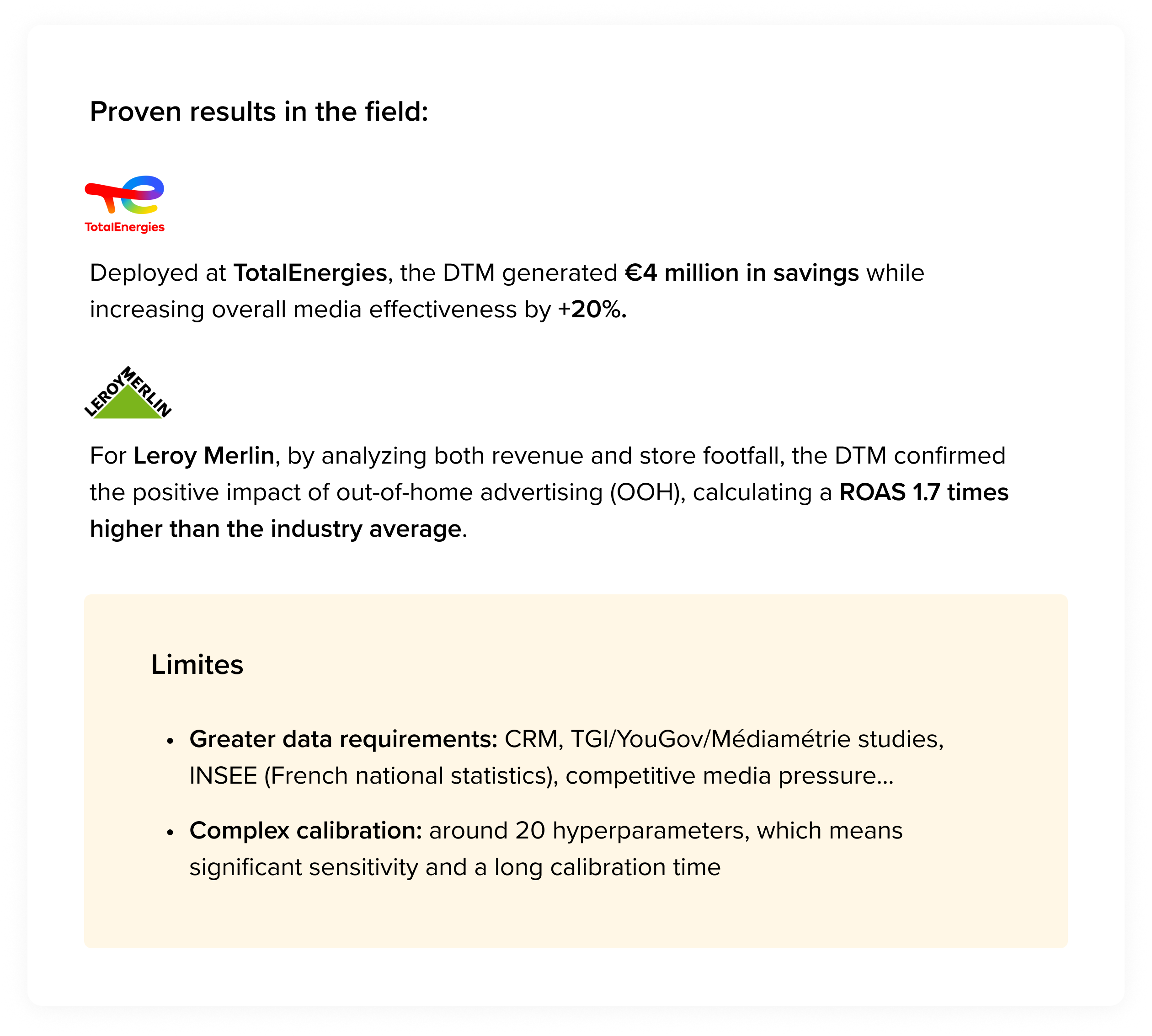
    • Multi-KPI & long-term steering: In addition to a business KPI (Acquisition, Sales, Revenue…), other KPIs can be assessed directly, especially Branding KPIs. This makes it possible to measure the real value of a point of awareness or consideration on future sales. A traditional MMM "forgets" a media cut within a few weeks. In the DTM, consideration and awareness evolve slowly and non-linearly. Lost points are costly to win back, and the gap is still measurable a year later.
    • Media and geographic granularity : Analysis by campaign objective (brand, consideration, performance) and by source (Instagram, TikTok, TF1, M6, etc.). Fine geographic breakdown (store, regional and national levels), where the sum of the regions exactly equals the national total.
    • Adding new levers: By design, a lever the advertiser has never activated before can be included, since the modeling relies on that lever's impact on the population of twins rather than on historical data.  

3. Strategic Complementarity: The Meridian or PyMC + DTM Alliance

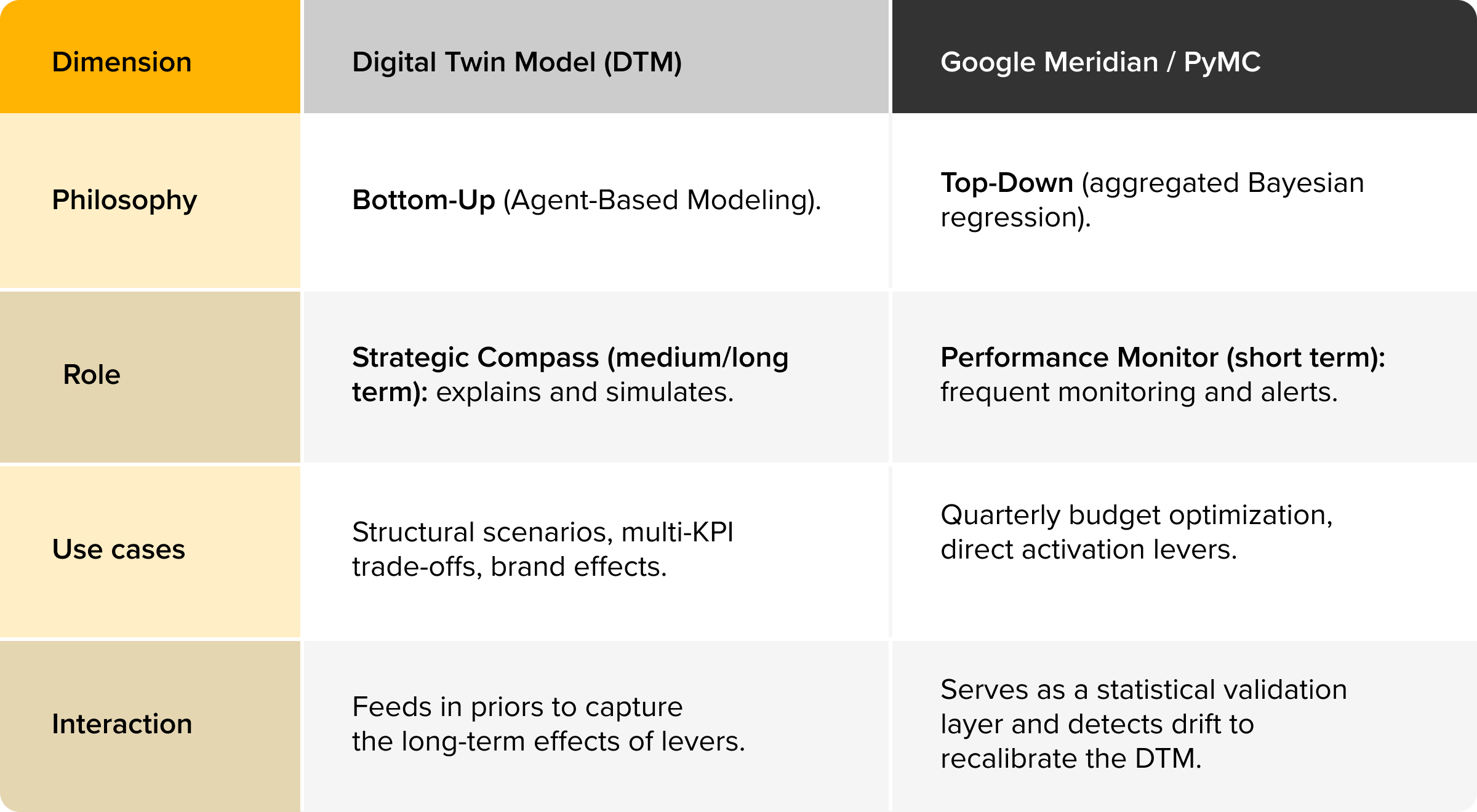
fifty-five's approach does not pit Bayesian models against digital-twin simulation; instead, it combines them within a continuous steering loop. The Digital Twin Model acts as a medium- to long-term strategic compass: it makes behavioral mechanisms explicit, assesses brand value and provides Meridian or PyMC with a causal structure and well-founded priors. Conversely, Meridian or PyMC is used to measure variations observed on direct levers more frequently, serving as a fast statistical validation layer and an early-warning indicator for fine-tuning the DTM's calibration on an ongoing basis.
4. Decision Matrix: Which Offering to Recommend?

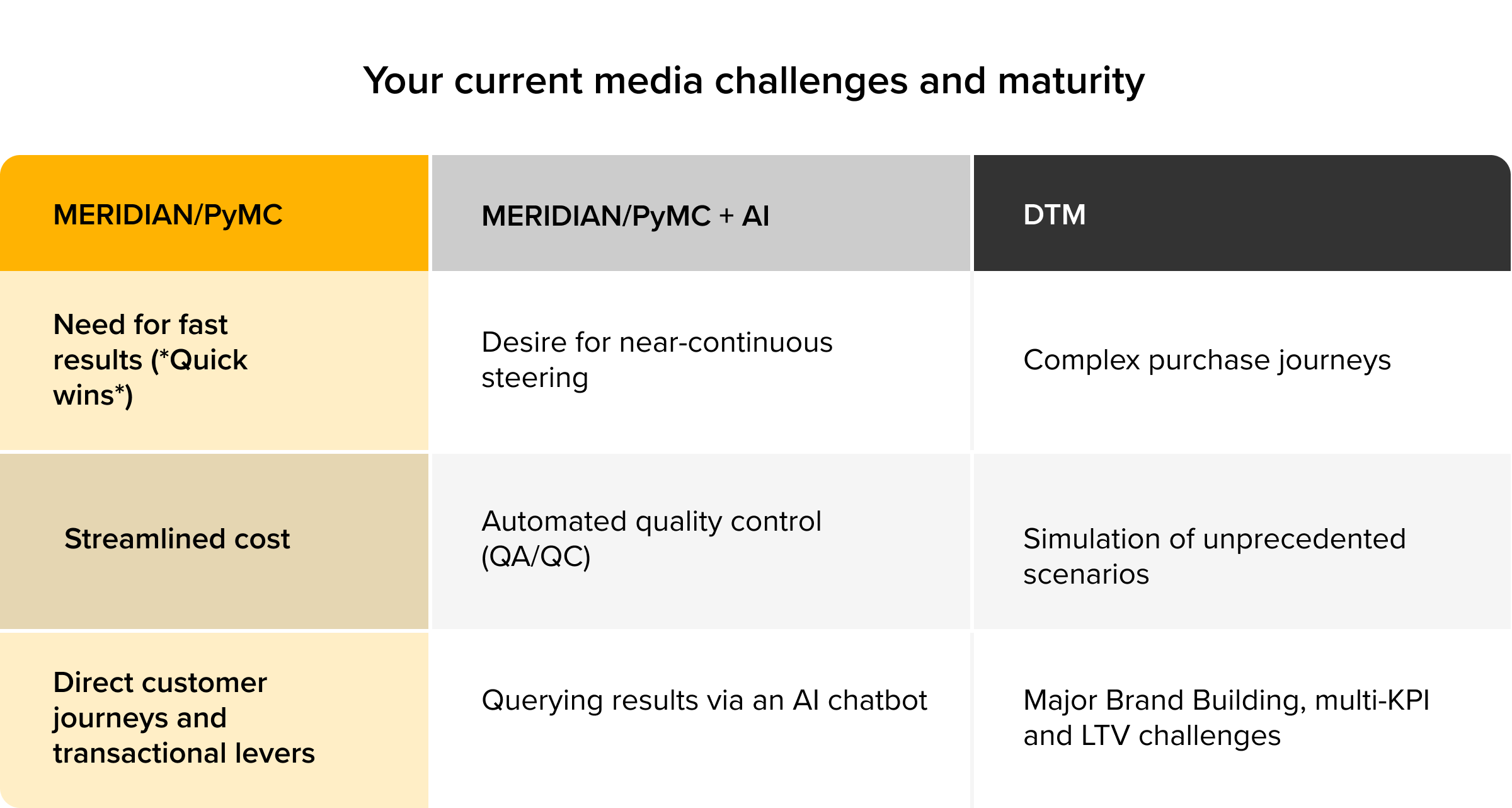
The right path depends directly on objectives, scope (geographies, brands) and maturity in marketing measurement and data. Implementing Meridian or PyMC is recommended for companies seeking agile budget validation on direct customer journeys and short-term activation channels. The AI-augmented option is particularly well suited to organizations looking to automate their data flows and establish continuous steering. Finally, the Digital Twin Model is the natural choice for players facing complex purchase journeys and multi-KPI trade-offs between brand image and conversion, or wishing to simulate structural budget decisions. Within an international organization, depending on the markets or brands to be modeled, several models can coexist while sharing a common technological and organizational foundation to run the MMM program. By building an internal, long-lasting decision-making asset in this way, brands secure controlled, predictive management of their future growth.  

Combining the rigor of open-source Bayesian algorithms with the innovation of Agent-Based Modeling, fifty-five has established itself as a pioneer in next-generation marketing measurement. Its R&D work has been published in renowned international scientific venues (notably at the IFAAMAS academic AI conference).

Adopting a Next-Gen MMM is not about buying yet another piece of software, but about building an internal, long-lasting and scalable decision-making asset. Whether you want to start with an agile first step using Meridian to prove the value of MMM, or deploy the predictive power of the Digital Twin Model from the outset, fifty-five supports you from data structuring all the way to adoption by your operational teams. Contact our teams for a flash audit of your current models or to schedule a tailored demo of the Digital Twin Model.

References and glossary 

1Study by Google & BCG

2Frequentist approaches: These estimate the effect of each marketing lever solely from historical data, usually through mathematical regression. The result is a single value per parameter, together with a confidence interval. They are quick and simple to implement, but become unstable when data is limited or channels are highly correlated.

3Bayesian approaches: These combine historical data with prior knowledge ("priors"), such as benchmarks, incrementality test results or business expertise. Instead of a single value, they give a distribution of probable values for each parameter, which makes uncertainty explicit. They are more robust when data is scarce, but require more computation and well-justified choices of priors. This is the approach taken by recent open-source frameworks such as Meridian (Google) and PyMC-Marketing.

4Synthetic population: A set of fictional individuals created to reproduce the statistical characteristics of a real population: socio-demographic distribution, purchasing behavior, media exposure… Each individual is invented, but the whole is representative. It is built from aggregated sources such as census data, panels or first-party data. It is used to simulate behaviors or test scenarios without using any personal data.

All articles

Related articles

The Digital Twin Model (DTM): fifty-five’s Next-Generation Marketing Mix Modeling Solution

3mn
fifty-five

Thirsty for more expert insights? Subscribe to our monthly newsletter.

Discover all the latest news, articles, webinar replays and fifty-five events in our monthly newsletter, Tea O'Clock.

First name*
Last name*
Company*
Preferred language*
Email*
Merci !

Votre demande d'abonnement a bien été prise en compte.
Oops! Something went wrong while submitting the form.