


Recently, while working on SEO/GEO AI agent projects, I started exploring how modern data architectures could better support agents in performing complex queries and generating deeper insights from both structured data and unstructured sources, such as HTML content and SERP results. This led me to learn about the concept of the Data Lakehouse and its potential to support AI-driven analytics.
Data lakehouses are an important architectural option for organizations that need to govern diverse data and support analytics and AI from a shared foundation. They can reduce unnecessary data copying and make raw and curated data available to multiple processing engines, but they do not remove the need for data modeling, pipelines, quality controls, or workload-specific systems.
In this article, I will explain the data lakehouse architecture, its contribution to AI workloads, a reference implementation on Google Cloud, and the situations in which a data warehouse or a hybrid design may remain the better choice.
First, a brief definition: a data lakehouse is a modern data architecture that combines the flexibility and storage economics of a data lake with transaction management, governance, and analytical capabilities traditionally associated with a data warehouse. It is an architectural pattern rather than a single type of database. Raw data and curated business data can coexist on shared object storage and be accessed by compatible analytics, data engineering, and AI services. [1]
Open table formats such as Apache Iceberg, Delta Lake, and Apache Hudi add table metadata and management features to files stored in object storage. Depending on the format and platform, these features can include Atomicity, Consistency, Isolation, and Durability (ACID), schema and partition evolution, historical snapshots, and support for multiple processing engines. [2][3][4] A lakehouse can therefore reduce duplicate copies and unnecessary data movement, although organizations still need ingestion, transformation, testing, and governance processes.
A practical lakehouse usually combines five architectural components:
A lakehouse provides a governed data foundation for AI, but it is not a complete AI or retrieval platform by itself. Capabilities such as document parsing, vector indexing, retrieval-augmented generation (RAG), model serving, and Agent memory require additional services and application logic. The table below separates the lakehouse contribution from those complementary requirements.
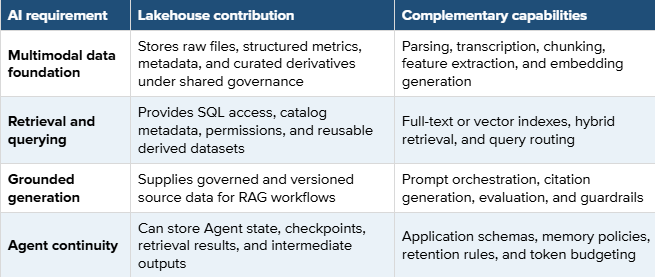
Data lakehouse architecture is supported by major cloud and data platforms, including Databricks, Snowflake, AWS, Microsoft Fabric, and Google Cloud. These platforms offer different combinations of scalable cloud storage, data processing, governance, and analytics capabilities, enabling organizations to manage diverse data types and support BI, data engineering, and AI workloads.
As a Google Cloud partner, fifty-five is particularly interested in its lakehouse implementation. Therefore, I will be focusing here on Google Cloud's Borderless Lakehouse, which integrates managed services to provide a shared data foundation for analytics and AI.
Google Cloud implements its Borderless Lakehouse through a combination of managed services rather than one standalone product. Its architecture can be organized as follows [5]:
The two architectures overlap, and modern data warehouses increasingly support semi-structured data, machine learning, and vector search. The distinction is therefore about architectural emphasis and workload fit rather than a strict division of capabilities.
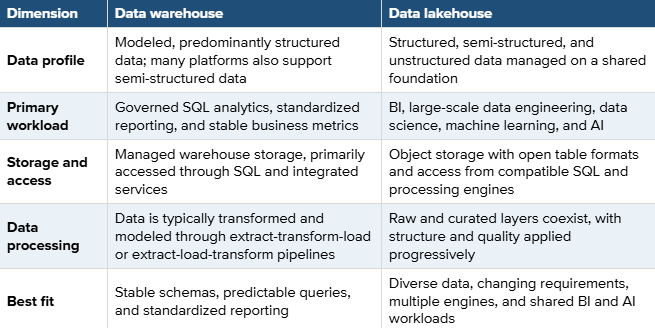
A data warehouse is often the simpler choice when the workload consists mainly of stable structured data and standardized reports. A lakehouse becomes more valuable when raw and curated data must coexist, several processing engines need governed access, or AI applications require evidence from diverse sources. In practice, a hybrid architecture is often the most pragmatic choice: the warehouse serves high-value analytical models, while the lakehouse manages open, large-scale, and multimodal data.
A data lakehouse is particularly useful when an organization needs to govern diverse data and support business intelligence, data engineering, machine learning, and AI from a shared foundation. It does not automatically replace a data warehouse, which may remain simpler and more efficient for stable structured analytics and standardized reporting. Organizations should choose between warehouse, lakehouse, and hybrid architectures based on their data types, performance requirements, governance needs, team capabilities, and total operating cost.
[1] Google Cloud What is a data lakehouse
[2] Apache Iceberg Documentation
[5] Google Cloud Lakehouse key concepts
[6] Google Cloud Create data agents in BigQuery
[7] Google Cloud Use the BigQuery MCP server
[8] Google Cloud Lakehouse pricing

Discover all the latest news, articles, webinar replays and fifty-five events in our monthly newsletter, Tea O'Clock.