



At fifty-five, we choose to approach AI as a legitimate operational and business tool. Our teams treat prompting as a core skill, not a secondary adjustment. As we’ve been able to verify time and time again, well-designed prompts generate useful results with fewer iterations, which helps control costs as well as the environmental footprint of AI usage. Good prompting is how you can embed AI into your workflows without risking clarity, accountability, or performance loss.
LLMs will always return an answer. While this certainty is part of their appeal, it also creates a false sense of reliability, as outputs may sound confident while being inaccurate, incomplete, or even misaligned with the initial objective. Poor prompting often leads to repeated generation and additional verification work that cancels out any possible productivity gain and needlessly increases carbon emission.
Good prompting reframes AI as a professional co-pilot instead of a driver, encouraging teams to formalize their needs and structure their thinking before involving an AI model. This preliminary discipline significantly improves output quality and makes AI usage more predictable and scalable.
There are also concrete economic and environmental implications, as every request has both a cost and a carbon footprint. Improving prompt quality reduces unnecessary calls, optimizes token usage, and contributes to more responsible AI practices; for organizations, this directly supports performance as well as digital sobriety objectives. To learn more about the environmental impact of AI usage, read our latest study with the Brandtech Group and Scope3.
Effective prompting begins with framing the problem. Teams must first assess whether AI is relevant, what efficiency gain is expected, and which risks or constraints apply. While summarizing long documents is certainly a pertinent use case for AI, this technology should be used with more care for research work, for example.
Once you have confirmed that AI is the best answer for your needs, the next step is to select the most suitable model. Different models (from different AI providers, of course, but also different generations of the same model) imply different trade-offs in reasoning power, speed, cost, deployment architecture, and data governance.
For fifty-five projects, we integrate the model assessment phase into our broader AI architecture approach, aligning business goals and technical setup. This ensures consistency with security requirements, operational constraints, and long-term scalability.
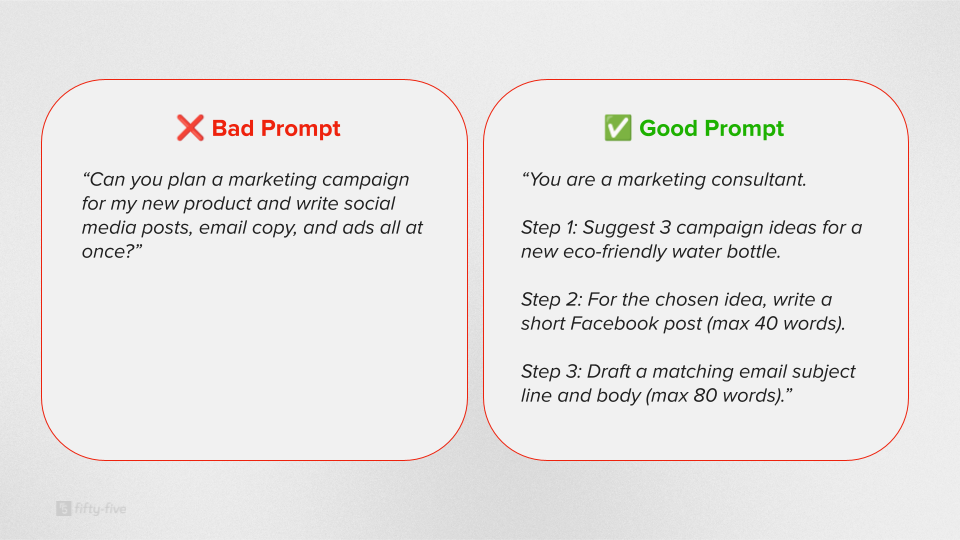
Good prompting relies on two essential principles: clarity and structure.
Clarity means stating explicitly what is expected. The role the AI should play, the business context, the target audience, and the objective of the task must be unambiguous and clearly stated within the prompt itself, which already increases outcome quality.
Structure ensures that the model can correctly interpret the request. Separating context, source material, tasks, and output constraints makes prompts more robust and easier to reuse. Structured prompts also improve consistency, especially when embedded into automated workflows or internal tools – we recommend centralizing these prompts (on a dedicated drive, for instance) to share them more easily across teams and contributors.
No prompt, however well formulated, removes the need for human responsibility. AI outputs must systematically be reviewed and validated. This is particularly critical in client-facing, strategic, or automated contexts, where errors or biases can have direct business consequences, such as:
At fifty-five, we see taking ownership of AI-assisted production is a central principle. AI accelerates execution and exploration, yes, but it does not replace expertise or judgment, and it cannot take accountability. Responsible prompting must also include strict attention to data confidentiality and tool governance, ensuring that sensitive data is only used within specific environments.
Good prompting can improve reliability, reduce waste, and strengthen the link between human expertise and machine capabilities. By treating prompting as a professional discipline, organizations can move beyond experimentation and deploy AI in ways that are truly aligned with long-term business and sustainability objectives. But keep in mind that good prompting cannot be isolated from broader AI practices. It must be connected to business priorities, model strategy, technical architecture, and team empowerment.

Discover all the latest news, articles, webinar replays and fifty-five events in our monthly newsletter, Tea O'Clock.





.png)